

An artificial intelligence (AI) gut check.
Last week, U.S. stock markets dropped sharply as investors reconsidered the growth potential of AI companies. These companies have been the focus of the market’s attention for a long time. Since January 2024, 42 AI stocks have accounted for about 60 percent to 80 percent of the earnings growth and returns of the Standard & Poor’s (S&P) 500 Index, according to Michael Cembalest of J.P. Morgan.
Re-assessing the risks and rewards of AI
Recently, investor exuberance has waned, and markets have cast a more critical eye on the potential risks and rewards of AI investments. They’ve been considering:
- The rising cost of capital. Capital is the money companies receive from investors who buy their stocks and bonds. The cost of capital is the return investors expect to receive, so company projects must generate enough revenue to meet those expectations. When interest rates rise, companies pay more to fund their projects and need to realize a bigger payoff to meet expectations.
- A limited energy supply. There are concerns about whether the U.S. electrical grid can actually supply all of the energy that data centers need, and how high demand will affect energy prices for other consumers, reported Mia Osmonbekov of Fortune. Companies want more power, delivered faster, than the grid can handle, said a source cited by Osmonbekov. While companies typically request power within two years, U.S. power projects that came online in 2025 spent “a median of five years from requesting a grid connection to operating commercially.”
- Demand for chips. One of the factors supporting rising stock prices for chipmakers has been high demand for chips. That raises an important question, Rich Privorotsky of Goldman Sachs asked, “So if you can’t get the power to actually energize a data center, will you actually be able to consume the chips you’ve already forward ordered?”
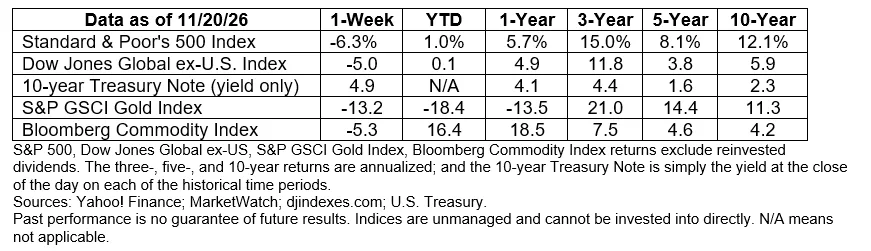
Last week, sentiment around AI soured and the market corrected. In fact, we saw both a market correction and a bear market. The Standard & Poor’s (S&P) 500 Index moved into correction territory, meaning that it was 10 percent below its previous high. The technology sector of the Index fell more than 20 percent, putting it into a bear market, according to Maya Drew Smith of Barron’s.
Double-digit earnings growth was below expectations
When markets turn lower, it’s always a good idea to keep an eye on fundamentals, including earnings, cash flow, debt, and valuations. Companies with strong fundamentals are likely to perform better than companies with poor fundamentals. Third quarter earnings season just ended. John Butters of FactSet reported that the Magnificent 7 (seven of the largest and most influential tech firms) fell short of expectations. “On September 30, the estimated earnings growth rate for the ‘Magnificent 7’ companies for Q3 2026 was 33.6 percent.” The blended earnings growth rate for the other 493 companies in the S&P 500 Index was 34.7 percent.
Major U.S. stock indexes finished last week lower, while the bond market rallied. Yields on most maturities of U.S. Treasuries moved lower over the week.
Market downturns remind us of the reasons for portfolio diversification. It can be tempting to concentrate your portfolio in one sector or another, but prudent investors know that diversification can help protect your portfolio in market downturns. If you would like to discuss market performance, your portfolio, or anything else, please get in touch.
WE’RE IN A TECHNOLOGY BEAR MARKET. If you were a fan of the survival series Alone, you may remember that tension always ratcheted higher when participants encountered bears. Some lived warily alongside the creatures, while others chose to tap out. A similar thing happens among investors when they encounter a bear market.
It can be unnerving to watch the value of investments fall as happened last week. Emotions run high. Headlines forecast doom and gloom. At times like this, it’s important to keep a clear head because the decisions you make can have a significant effect on the value of your portfolio over the long-term. During market downturns, investors have options, and not all of them are good ones. They may choose to:
- Sell. The thinking behind selling is usually something like this: If I sell, I will cut my losses and preserve what I have. Investors who go that route are willing accept a loss of principal, which may hurt their ability to reach long-term financial goals.
- Stay invested. Investors who remain invested recognize that a market decline is not the same as a loss of principal. By remaining invested, they create an opportunity to regain lost value should the market change direction.
- Look for opportunities. Some investors recognize that market downturns may create buying opportunities. These investors work with their advisors to identify ways to position for gains should the market recover. The goal of investing, after all, is to buy low and sell high.
If you’re feeling worried about the current downturn, it may be reassuring to review the history of the stock market. For instance, during the 2008-09 financial crisis and recession, the S&P 500 Index dropped from a high of about 1,562 on October 12, 2007, to about 891 on December 30, 2008. It took several years for the Index to recover.Last week, the S&P 500 Index moved into correction territory and closed at 6,910. Of course, past performance is no guarantee of future results.
“Be fearful when others are greedy and greedy when others are fearful.” ― Warren Buffett, Investor and philanthropist
Investment advisory services offered through Keystone Financial Services, an SEC Registered Investment Advisor. These views are those of Carson Coaching, not the presenting Representative, the Representative’s Broker/Dealer, or Registered Investment Advisor, and should not be construed as investment advice. This newsletter was prepared by Carson Coaching. Carson Coaching is not affiliated with the named firm or broker/dealer. Government bonds and Treasury Bills are guaranteed by the U.S. government as to the timely payment of principal and interest and, if held to maturity, offer a fixed rate of return and fixed principal value. However, the value of fund shares is not guaranteed and will fluctuate. Corporate bonds are considered higher risk than government bonds but normally offer a higher yield and are subject to market, interest rate and credit risk as well as additional risks based on the quality of issuer coupon rate, price, yield, maturity, and redemption features. The Standard & Poor’s 500 (S&P 500) is an unmanaged group of securities considered to be representative of the stock market in general. You cannot invest directly in this index. All indexes referenced are unmanaged. The volatility of indexes could be materially different from that of a client’s portfolio. Unmanaged index returns do not reflect fees, expenses, or sales charges. Index performance is not indicative of the performance of any investment. You cannot invest directly in an index. The Dow Jones Global ex-U.S. Index covers approximately 95% of the market capitalization of the 45 developed and emerging countries included in the Index. The 10-year Treasury Note represents debt owed by the United States Treasury to the public. Since the U.S. Government is seen as a risk-free borrower, investors use the 10-year Treasury Note as a benchmark for the long-term bond market. Gold represents the 3:00 p.m. (London time) gold price as reported by the London Bullion Market Association and is expressed in U.S. Dollars per fine troy ounce. The source for gold data is Federal Reserve Bank of St. Louis (FRED), https://fred.stlouisfed.org/series/GOLDPMGBD228NLBM. The Bloomberg Commodity Index is designed to be a highly liquid and diversified benchmark for the commodity futures market. The Index is composed of futures contracts on 19 physical commodities and was launched on July 14, 1998. The DJ Equity All REIT Total Return Index measures the total return performance of the equity subcategory of the Real Estate Investment Trust (REIT) industry as calculated by Dow Jones. The Dow Jones Industrial Average (DJIA), commonly known as “The Dow,” is an index representing 30 stock of companies maintained and reviewed by the editors of The Wall Street Journal. The NASDAQ Composite is an unmanaged index of securities traded on the NASDAQ system. International investing involves special risks such as currency fluctuation and political instability and may not be suitable for all investors. These risks are often heightened for investments in emerging markets. Yahoo! Finance is the source for any reference to the performance of an index between two specific periods. The risk of loss in trading commodities and futures can be substantial. You should therefore carefully consider whether such trading is suitable for you in light of your financial condition. The high degree of leverage is often obtainable in commodity trading and can work against you as well as for you. The use of leverage can lead to large losses as well as gains. Opinions expressed are subject to change without notice and are not intended as investment advice or to predict future performance. Economic forecasts set forth may not develop as predicted and there can be no guarantee that strategies promoted will be successful. Past performance does not guarantee future results. Investing involves risk, including loss of principal. The foregoing information has been obtained from sources considered to be reliable, but we do not guarantee it is accurate or complete. There is no guarantee a diversified portfolio will enhance overall returns or outperform a non-diversified portfolio. Diversification does not protect against market risk. Asset allocation does not ensure a profit or protect against a loss. Consult your financial professional before making any investment decision.